
Vagus Nerve Stimulation: Methods, Devices and Their Limits
You are lying in bed in the evening, your mind keeps running, and somewhere you read that a single nerve is to blame. For some years now the vagus nerve has been the favorite topic of advice sites, and the promises around it have grown big. This page does the opposite. It explains what the vagus nerve is, which methods engage it at all, where the evidence is thin, and what devices in this field do. Including our own. We sell the neuroVIZR, and that is exactly why the most important sentence comes right at the start: the neuroVIZR is not a vagus nerve stimulator.
The Essentials in Brief
- The vagus nerve is the tenth cranial nerve and the largest nerve of the parasympathetic nervous system. It runs from the brainstem through the neck into the chest and abdomen.
- The most accessible methods cost nothing: exhaling slowly, humming, cold water on the face, a quiet moment without a task.
- Targeted electrical vagus nerve stimulation is something different from a wellness application. It belongs in medical hands. Wellness devices sold over the counter are not approved for it.
- The neuroVIZR works with light pulses and sound and does not stimulate the vagus nerve. It is a wellness device for a quiet moment, CHF 599.00 (ORIGINAL) and CHF 749.00 (Rouge).
- The body of research on the simple exercises is slim and the studies are mostly small. Anyone promising you fast and lasting effects is overstretching the sources.
On this page:
- What the vagus nerve is and why everyone is talking about it
- What you can do right now
- What counts over weeks
- Devices compared: what they do and what they don't
- Safety, limits and when to see a doctor
- Frequently asked questions
- Sources
What the Vagus Nerve Is and Why Everyone Is Talking About It
The vagus nerve is the tenth of the twelve cranial nerves and the nerve with the longest course in the body. Its name comes from the Latin word for wandering, and that describes it well: it leaves the brainstem, runs down the side of the neck, supplies the larynx and pharynx, and continues on to the heart, the lungs and the organs of the abdomen. It is a mixed nerve, meaning it carries fibers in both directions. The majority of its fibers do not report from the head to the body but the other way around, from the body to the brain.
That makes it the most important strand of the parasympathetic nervous system, the part of the body responsible for recovery, digestion and regeneration. Its counterpart, the sympathetic nervous system, sets the body up for activity and tension. Both are constantly active and balance each other out. This picture is exactly where the nickname "rest nerve" came from, and the nickname turned into a promise: whoever operates this one nerve switches tension off.
It is not that simple. The vagus nerve is not a switch with two positions but part of a finely tuned control loop. What the popular exercises actually do is considerably more modest and still not worthless: they act on bodily functions connected to this nerve, above all on breathing.
One question can be answered clearly at this point: whether your vagus nerve is impaired is not something you can determine at home. There is no self-test for it, no app and no home remedy. Anyone with that suspicion has it checked by a doctor, not with an exercise from social media.
What You Can Do Right Now
The common methods fall into two groups, and this separation makes all the difference: there are things you can try in the next two minutes, and there are things that only mean something over weeks. Here first the short group. It costs nothing, needs no device, and nobody has to sell you anything for it.
Exhale Slowly and, Above All, for a Long Time
This is the best-studied method in the group. The approach is simple: breathe in through your nose and let the exhale last noticeably longer than the inhale, roughly four seconds in and six to eight seconds out, for a few minutes. A systematic review from 2018 compiled what has been measured on slow breathing, from heart rate variability to values from EEG recordings. The authors expressly describe the body of research as inconsistent, with studies differing greatly in methodology and quality. A second article from the same period proposes an explanatory model for how breathing and the vagus nerve interact. A model is an explanation, not proof. Taken together, this means: slow exhaling is the most plausible and cheapest method in the whole field, but nobody can seriously tell you what it will do for you personally.
Humming, Singing and Gargling
The vagus nerve supplies the larynx, which is why humming, loud singing and gargling appear in almost every list of exercises. A small pilot study using functional imaging examined what becomes visible in the brain when humming the sound Om. It had few participants, was a preliminary study, and proves nothing on its own. What speaks for the method is something else: it automatically lengthens the exhale. Anyone who hums exhales for a long time without counting. For many people, that is the easier route into the same thing.
Cold Water on the Face
Cold water on the face and forehead, a cold cloth on the back of the neck, or the last thirty seconds of the shower cold: that is the second standard method. The body responds to cold on the face with an innate reflex that, among other things, influences heart rate. What matters is the classification: this is a brief physical stimulus, not a program. Anyone with heart or circulatory problems discusses cold applications with a doctor first instead of simply trying them.
Neck and Ear: The Most Popular Misconception
One question keeps coming up in this field: where do you massage the vagus nerve? The honest answer: you don't. In the neck, the nerve runs in a vascular sheath together with the carotid artery, that is, at a spot where firm pressure is not only useless but unwise. What is meant in practice is a gentle neck massage or light stroking along the muscles at the side of the neck, and what eases as a result is muscular tension. That is pleasant and perfectly fine. It is just not what the term vagus massage promises. Keep your fingers away from firm pressure on the neck, especially on both sides.
What all four methods have in common is unspectacular and rarely said out loud: they force you to do nothing else for a few minutes. Part of what people feel in the process comes from exactly that. Neurologist Cecilia Friedrichs-Maeder of Inselspital Bern put it roughly this way in an SRF Puls report from November 12, 2025: a short-term effect is plausible, if only because you take time for yourself. On the exercises themselves, she is quoted there verbatim (translated from the German): "As for the vagus nerve stimulation techniques promoted on social media, I see no risk in them as such."
What Counts Over Weeks
Regularity Beats Intensity
The same SRF report contains the assessment that every honest page on this topic has to withstand. Friedrichs-Maeder speaks there about medically supervised stimulation in her patients, that is, about something considerably stronger than a breathing exercise in the evening. Even there, she says, the effects are not impressive and only show after several months, and if the stimulation is stopped, they disappear again. That is uncomfortable for anyone selling a device, and it is still the most sensible expectation you can bring. Two minutes of breathing exercise on a bad evening are not a rebuild of your nervous system. A small thing that you do almost every evening for eight weeks is a habit, and habits are the only thing in this field that reliably builds up.
The Evening as a Fixed Anchor
In practical terms: pick a single method, not five, and attach it to something that happens every evening anyway, to brushing your teeth or to switching off the light. Five minutes of long exhaling after brushing your teeth is a routine that holds. An ambitious twenty-minute program is over after ten days. If you want to go deeper on the topic of sleep, you will find more on our page on natural sleep aids and on calming the nervous system.

Devices Compared: What They Do and What They Don't
As soon as devices come into play, things get confusing, because marketing pushes very different things under the same term. So here is the separation that counts. There are devices that actually stimulate the vagus nerve electrically via electrodes. And there are devices that create a relaxation experience with vibration, sound, light or guided breathing and do not touch the nerve directly. Both groups are sold side by side, and only the first has anything at all to do with the word stimulation in the medical sense.
This comes with the statement that carries the most weight in Switzerland and that appears verbatim in the SRF report mentioned above (translated from the German): "To this day, none of these devices is approved for treatment." Anyone who has a diagnosis and is looking for treatment is in the wrong place with any wellness device, including ours.
The following prices were collected directly from the manufacturers on August 20, 2026, each in the currency the shop itself displays. We do not convert them into Swiss francs, because exchange rate, shipping and import shift the result. Where a detail could not be verified, that is stated explicitly instead of an estimated figure.
| Device | Principle according to the manufacturer | Where on the body | Length of a session | Electrical vagus nerve stimulation | Price, collected on August 20, 2026 |
|---|---|---|---|---|---|
| neuroVIZR | Light pulses and sound in a fixed composition | In front of the closed eyes, on the head | depends on the program | No | CHF 599.00 (ORIGINAL), CHF 749.00 (Rouge) |
| Sensate | Infrasonic resonance, perceptible vibration | On the breastbone, lying down | not collected | No | GBP 299.00 (single device) to GBP 1,141.00 (pack of four), getsensate.com |
| Moonbird | Guided breathing, the device expands and contracts | In the hand | not collected | No, it guides your breathing | EUR 179.00, with premium app EUR 199.99 (moonbird.life) |
| Apollo Neuro | Vibration on the skin | Wrist or ankle | not collected, modes run over the course of the day | No | USD 448.00 (apolloneuro.com, wearable including a one-year SmartVibes membership) |
| Pulsetto | Electrical stimulation via electrodes on the neck | Neck | not collected | Yes, according to the manufacturer | not collected, product page returned error 404 |
Where the neuroVIZR Stands
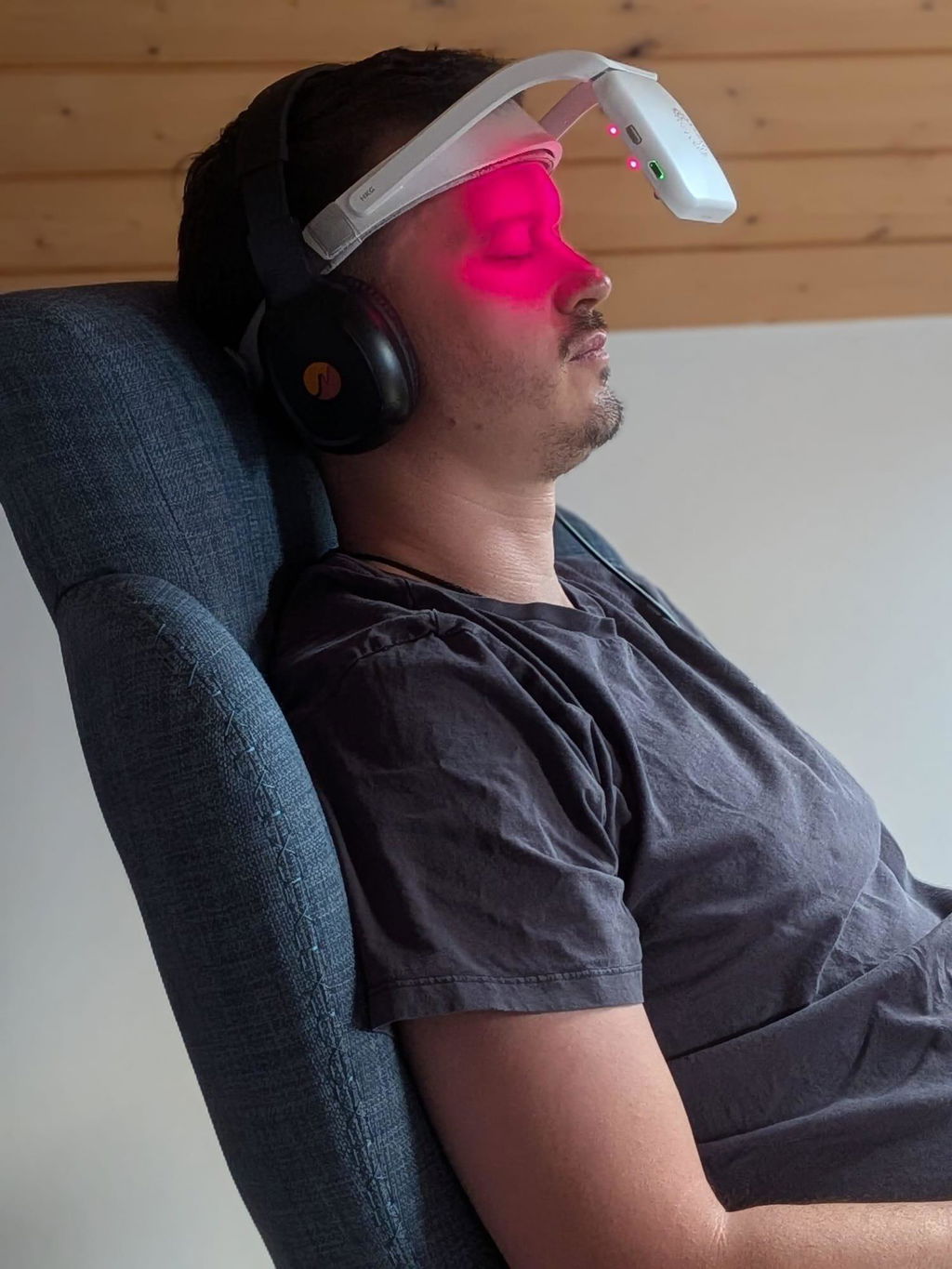
Four of the five devices in this table do not stimulate the vagus nerve electrically, and the neuroVIZR is one of them. It belongs in a different category: light and sound. You put it on, close your eyes, and a fixed composition of light pulses and tones runs. The length depends on the program you choose. You do not have to do anything right, count anything or be able to do anything. That is exactly the difference from a breathing exercise, and for some people it is the decisive one, because they regularly fail at meditation and breathing techniques.
What the neuroVIZR is: a wellness device for a quiet moment in the evening or for a short reset between two appointments. What it is not: a medical device, a treatment, and precisely not a vagus nerve stimulator. The device's specific light and sound compositions have not been studied in controlled clinical trials. We would rather write that sentence ourselves than have you read it somewhere else.
neuroVIZR Fact Sheet
- Price: CHF 599.00 for the neuroVIZR ORIGINAL with 72 sessions and battery, CHF 749.00 for the Rouge Edition with red light at 670 nanometers
- Length of a session: depends on the program you choose
- Principle: light pulses via LED and matched sound, no electrical stimulation, no contact with the vagus nerve
- Follow-up costs: with the ORIGINAL, the premium content in the app is included; full access, "Premium Plus", is a paid upgrade in the app; with the Rouge, everything is included
- Returns: 30-day money-back guarantee, plus a 12-month warranty on the hardware
- Delivery: free shipping to Switzerland
- Discount: SWICA policyholders receive a discount of 200 francs through the active4life benefits program. You request the discount code with your insurance number
- Not suitable for: people with epilepsy or photosensitivity, during pregnancy, and for people under 18
- Category: wellness product, not a medical device

When Another Device Is the Better Choice
A comparison table in which your own product wins every row is not a comparison table. So here are the cases in which we advise you against the neuroVIZR. If you are specifically looking for electrical vagus nerve stimulation, the neuroVIZR is the wrong device, completely. Then the path leads through your doctor and through certified medical devices, not through a wellness shop. If guided breathing suits you and you want a small, inexpensive device, Moonbird is the more fitting and considerably cheaper purchase. If you are looking for something that runs unobtrusively on your wrist all day, Apollo Neuro is closer to what you want. And if a breathing exercise in the evening reliably does the job for you, then you do not need a device at all. That is a perfectly valid outcome of this page.
Safety, Limits and When to See a Doctor
Who Light and Sound Sessions Are Not Suitable For
The neuroVIZR works with rhythmic light pulses in front of closed eyes. Such pulses are unproblematic for most people, but not for all. You should not use it if you have epilepsy or known photosensitivity, during pregnancy, or if you are under 18. Caution is also advised with migraine with aura. If you take medication that increases light sensitivity or have a neurological condition, check with your doctor before use. And, very practically: not while driving, not while operating machinery. If you feel unwell during a session, stop. There is no reason to grit your teeth through a wellness application.
When Should You See a Doctor?
There is a point at which exercises and devices are the wrong tool, and it is reached much earlier than many think. Talk to a doctor if you have been sleeping badly for several weeks and are not functioning during the day, if tension, worries or low mood dominate your everyday life, if palpitations, dizziness, persistent stomach or bowel complaints, difficulty swallowing or persistent hoarseness occur, or if you yourself have the feeling that something is not right. If you already take medication, you do not change that medication on your own, neither because of an exercise nor because of a device. That decision is made by the doctor who prescribed it.
Frequently Asked Questions
Where do I massage the vagus nerve?
You don't. The nerve lies in the neck next to the carotid artery, and that is not a place to press. What is meant is a gentle neck massage, and what eases is muscle tension, not nerve activity. Keep your fingers away from firm pressure on the neck, especially on both sides at once.
Can you stimulate the vagus nerve yourself?
Directly and in a targeted way, not without a device and without medical supervision. Indirectly, you can engage the parasympathetic nervous system through breathing, humming and cold stimuli. That is the honest scope of what is possible at home.
Is the neuroVIZR a vagus nerve stimulator?
No. The neuroVIZR works with light and sound and has no contact with the vagus nerve and no electrodes. It is a wellness device for a moment of calm. Devices that actually stimulate electrically work with electrodes on the neck or ear and are a different product category.
How much does the neuroVIZR cost in Switzerland?
The neuroVIZR ORIGINAL costs CHF 599.00 in Switzerland, the Rouge Edition with red light CHF 749.00, and entry with the neuroVIZR LITE (runs on a cable, 6 sessions) is CHF 299.00, as of September 2, 2026. Shipping to Switzerland and Germany is free, you have a 30-day money-back guarantee and a 12-month warranty. With the ORIGINAL, the premium content is included; full access is a paid upgrade in the app; with the Rouge, everything is included.
Is there a discount for health insurance policyholders?
Yes, for SWICA policyholders. Through the active4life benefits program there is a discount of 200 francs. You request the discount code via the form at SWICA with your insurance number and receive it by email. The conditions are set out by SWICA itself. Other discount promises circulating online are not from us and are not valid.
How often should you stimulate the vagus nerve?
There is no robust general recommendation on this, and any precise number would be made up. What can be derived from the critique of this field: regularity over weeks is more plausible than a single long session, and according to current knowledge, effects do not persist once you stop.
Does it do anything at all, or is it just hype?
Both at once, and that is the most honest answer. Marketing in this field is well ahead of the data. The simple exercises are low-risk, cost nothing, and many people report that such an evening moment does them good. Large, lasting effects from a device sold over the counter are not proven, and anyone who promises them has not read the sources.
If light and sound are right for you: on this page you have read what the neuroVIZR is not. What it is, you decide in the end: a fixed point in the evening with your eyes closed, without a task and without having to be able to do anything. If that appeals to you, you will find the neuroVIZR ORIGINAL for CHF 599.00 and the Rouge Edition with red light for CHF 749.00 here. Free shipping to Switzerland and Germany, 30-day money-back guarantee, 12-month warranty. With the ORIGINAL, the premium content is included; full access is an upgrade in the app; with the Rouge, everything is included. If that does not appeal to you, you have found four methods on this page that cost nothing. With that, too, we have done our job.
Sources
- Kenny BJ, Bordoni B: Neuroanatomy, Cranial Nerve 10 (Vagus Nerve). StatPearls, NCBI Bookshelf. ncbi.nlm.nih.gov/books/NBK537171 (accessed August 20, 2026)
- Zaccaro A et al.: How Breath-Control Can Change Your Life: A Systematic Review on Psycho-Physiological Correlates of Slow Breathing. Frontiers in Human Neuroscience, 2018. PMC6137615 (accessed August 20, 2026)
- Gerritsen RJS, Band GPH: Breath of Life: The Respiratory Vagal Stimulation Model of Contemplative Activity. Frontiers in Human Neuroscience, 2018. PMC6189422 (accessed August 20, 2026)
- Kalyani BG et al.: Neurohemodynamic correlates of 'OM' chanting: A pilot functional magnetic resonance imaging study. International Journal of Yoga, 2011. PMC3099099 (accessed August 20, 2026)
- SRF Wissen: Vagusnerv stimulieren: Der einfache Weg zu weniger Stress? (in German; "Stimulating the vagus nerve: the easy way to less stress?"). SRF Puls report from November 12, 2025, with statements by neurologist Cecilia Friedrichs-Maeder, Inselspital Bern. srf.ch (accessed August 20, 2026)
- SWICA: active4life, neuroVIZR discount. swica.ch (accessed August 20, 2026)
- Competitor prices: apolloneuro.com, getsensate.com, moonbird.life, each collected in the currency of the respective shop on August 20, 2026.
Note: The neuroVIZR is a wellness product, not a medical device. It is not intended to diagnose, prevent or treat disease, and it does not replace medical advice, diagnosis or treatment. The information on this page is for general information purposes. If you have health complaints, consult a doctor.