
Calming the Nervous System: What Really Helps in the Evening
It is half past ten, the light is off, and your mind keeps working. The day is replayed once more, tomorrow is already being sorted, and the body stays in a tension that was useful in the morning and now only gets in the way. That is not a character flaw and not a sign of weakness. It is a nervous system that is still in work mode because nobody told it the day is over. This page sets out side by side the paths people actually use for this: what you can do in five minutes, what only holds up over weeks, and where neuroVIZR sensibly fits in and where it does not.
The Essentials in Brief
The autonomic nervous system has two operating modes: one for performance, one for recovery. Switching off in the evening means moving from the one to the other. The body responds fastest to breathing, more precisely to an exhale that lasts longer than the inhale. In the long run, what counts is less the individual exercise than the repetition: always the same bedtime, movement during the day, less bright light in the evening. A relaxation device replaces none of that. But it can be the fixed point that lets an evening routine come about in the first place, because you do not have to do anything right for it. The neuroVIZR ORIGINAL costs CHF 599.00 in Switzerland, the Rouge Edition with red light CHF 749.00, and entry starts with the neuroVIZR LITE at CHF 299.00. How long a session lasts depends on the program you choose.
On this page:
- What happens in the body, and why calming is not regulating
- What you can do in the next five minutes
- What holds up over weeks
- The methods side by side
- Light and sound: one option among several
- Where the limit lies
- Frequently asked questions
What Happens in the Body, and Why Calming Is Not Regulating
The autonomic nervous system controls everything you do not think about: heartbeat, breathing, digestion, muscle tension. It has two opposing players. The sympathetic nervous system sets the body up for action, the parasympathetic for recovery. Both are always active; only the ratio shifts. Anyone who has had appointments, screens and decisions all day comes home in the evening with a shift toward the sympathetic side, and that does not resolve itself just by lying down.
Typical of this are observations many people know: the pulse feels faster than it should be. The shoulders are pulled up without your having noticed. You are tired and at the same time too awake to fall asleep. These are everyday observations, not a diagnosis. When they need to be checked by a doctor is set out further down.
Calming and regulating are two different things. Calming means: I am wound up right now and am coming down now. That is a single process, it takes minutes, and it works for almost everyone. Regulating means: my system returns to rest mode by itself, without my having to intervene every time. That is a matter of habituation and takes weeks. The difference matters in practice because it explains why a single good breathing exercise on Tuesday evening changes nothing on Wednesday, and why the same exercise, thirty evenings in a row at the same point, is something else.
What You Can Do in the Next Five Minutes
These four things need no preparation, no accessories and no practice. They are what people fall back on when it is just too much right now.
Exhale Longer Than You Inhale
The simplest version: inhale for four counts, exhale for six to eight counts, six to ten times. What matters is not the number but that the exhale lasts longer. Slow breathing below about ten breaths per minute is among the best-studied self-help techniques of all: a review by Zaccaro and colleagues from 2018 compiled which physical and psychological changes were measured in healthy people during it.
Cold Water on the Face
Cold water on the forehead, cheeks and bridge of the nose, thirty seconds, or a cold, wrung-out cloth. The stimulus is strong enough that attention jumps away from the circling thoughts for a moment. Costs nothing, works in any bathroom, cannot be done wrong.
Humming, Singing, Gargling
A deep, long hum on the exhale, for one minute. If you are alone, you can also sing out loud or gargle with water for half a minute. All three incidentally force a lengthened exhale, which is the real common denominator.
See Five Things, Hear Four, Feel Three
The well-known 5-4-3-2-1 exercise: name five things in the room that you see, four that you hear, three that you feel, two that you smell, one that you taste. It brings attention out of the head and back into the room. Useful above all for people in whom breathing exercises tend to create even more tension.
What Holds Up Over Weeks
The quick help above is firefighting. What makes the evening calmer in the long term is four unspectacular habits, and three of them have nothing to do with relaxation in the narrow sense.
Always the Same Time
Going to bed and getting up within a half-hour window, on weekends too. The most boring point on the list and the one with the greatest leverage, because the body ties its rhythm to regularity, not to good intentions.
Movement During the Day, Not Right Before Bed
A meta-analysis by Kredlow and colleagues from 2015 evaluated 66 studies on the relationship between physical activity and sleep and describes small to medium effects on time to fall asleep, sleep duration and subjective sleep quality. A twenty-minute walk in the late afternoon is more realistic than a training plan you drop after ten days.
Turning Down the Light in the Evening
Bright, cool-white light late in the evening shifts the internal clock. An often-cited study by Chang and colleagues from 2015 compared what happens when people read on a light-emitting screen before bed instead of on paper: longer time to fall asleep, a shifted internal clock, less melatonin in the evening, less alert the next morning. In practice, that means: from about an hour before sleep, less ceiling light, more lamps at eye level, screens dimmer.
A Ritual That Does Not Depend on How Your Day Went
The point at which most good intentions fail: on the bad evening, when you would need it most, you have the least desire for an exercise that demands concentration. That is why rituals that always run the same way and demand no performance work better. Making tea. Reading for ten minutes. Always the same music. And, for some people, right here: a device that you put on and let run.
The Methods Side by Side
What most advice pages leave open is the honest time horizon. So here are all the paths in one table, with effort, cost and the state of the research. Not everything people use is well studied, and not everything that is well studied suits everyone.
| Method | Effort per day | What shows, and when | How well studied | Cost |
|---|---|---|---|---|
| Extended exhale | 2 to 5 minutes | during the exercise | good, systematic review available | none |
| Cold water on the face | under 1 minute | immediately | individual studies, small sample sizes | none |
| Humming, singing, gargling | 1 to 2 minutes | during the exercise | low, mostly small studies | none |
| Fixed bedtime | no time required, but discipline | after 2 to 4 weeks | good, standard in sleep research | none |
| Movement during the day | 20 to 45 minutes | after weeks | good, meta-analysis of 66 studies | none to low |
| Dimming the light in the evening | no time required | after days to weeks | good, controlled laboratory studies | none |
| Music and sound | 10 to 30 minutes | while listening | mixed, meta-analyses with very different results | none to low |
| Device with light and sound | one session, length depending on the program (neuroVIZR) | during the session; beyond that, no controlled data are available | low, the specific compositions have not been tested in controlled clinical studies | device, one-time: LITE CHF 299.00, ORIGINAL CHF 599.00, ROUGE CHF 749.00 (everything included); with the LITE and ORIGINAL, full access to the app is a paid upgrade |

Light and Sound: One Option Among Several
Some of the paths above require you to do something yourself: count, breathe, keep at it. That is exactly where many people fail on the evening they would need it most. That is why some reach for something that sets the sequence from the outside, from music to audio programs to devices with light and sound. The neuroVIZR belongs in this line, and it belongs there honestly placed: as part of an evening routine, not as a treatment and not as a substitute for the points above.
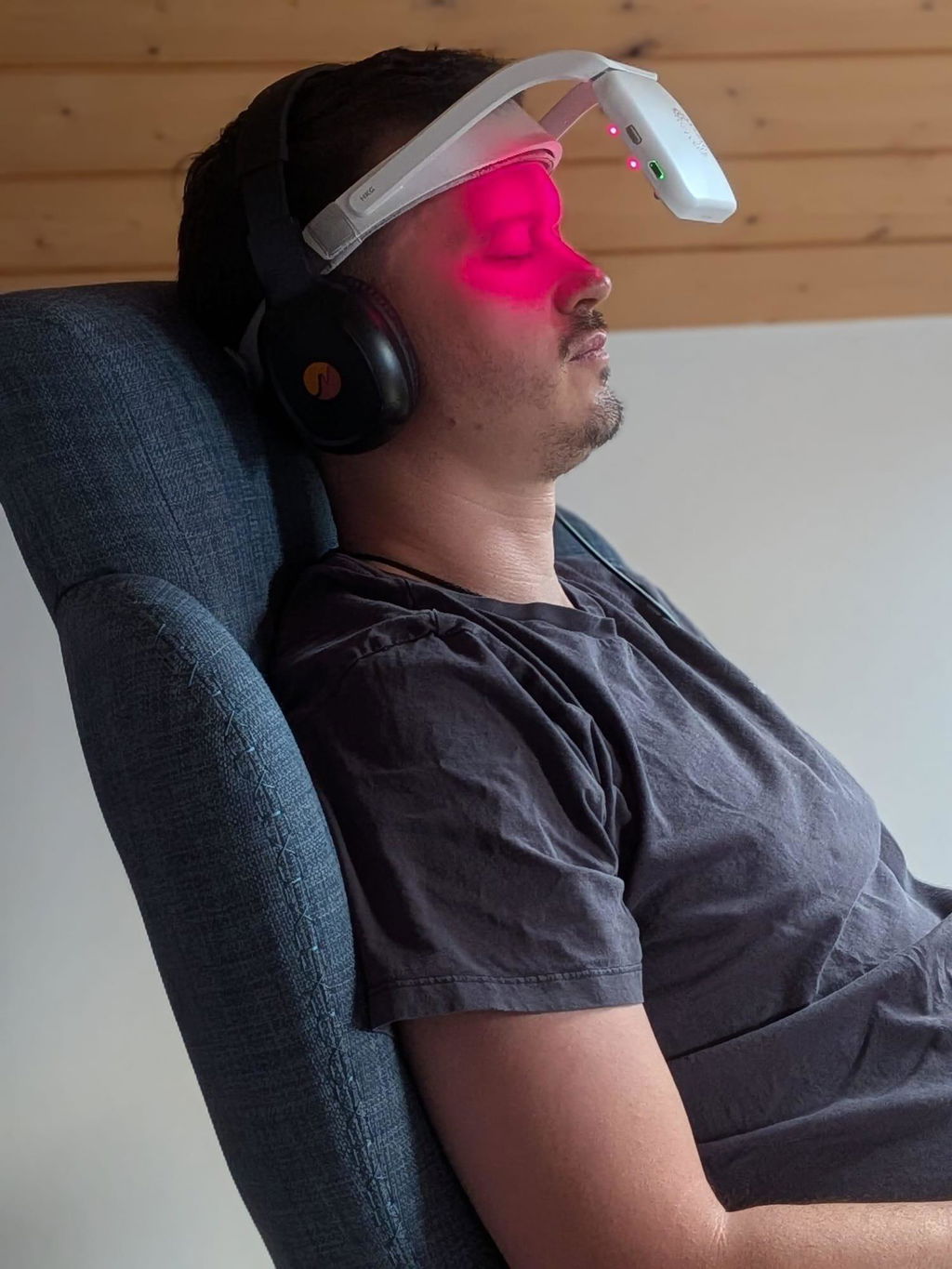
The neuroVIZR is a wellness device. You put on a headset, close your eyes, choose a program in the app and let it run. In front of your closed eyes, LEDs work with changing patterns, and a soundtrack comes through headphones. Nothing is stimulated electrically, nothing is measured, nothing is evaluated. The practical difference from a meditation app is that you do not have to do anything right: no focus, no technique, no self-observation. Anyone who gets along well with a breathing exercise, on the other hand, does not need a device for it.
neuroVIZR Fact Sheet
- What it is: light and sound wellness device, not a medical device, no electrical nerve stimulation
- Session length: depends on the program you choose
- Where on the body: headset in front of the closed eyes, sound through headphones
- Price in Switzerland: CHF 299.00 (LITE, white light, runs on a cable) · CHF 599.00 (ORIGINAL, white light) · CHF 749.00 (ROUGE, red light 670 nm)
- Subscription: with the ORIGINAL, the premium content is included; full access, Premium Plus, is a paid upgrade in the app; with the ROUGE, everything is included
- Follow-up costs: device one-time; with the LITE and ORIGINAL, full access to the app is a paid upgrade, with the ROUGE everything is included
- Returns: 30-day right of return
- Discount: SWICA policyholders receive a CHF 200 discount, redeemed via the insurance number in SWICA's active4life program
- Shipping: from Switzerland, no customs, no import
- Seller: Eternal Echo AG, Heubachstrasse 59, 8810 Horgen
- Battery life and delivery time: not publicly stated today
- State of research: the specific light and sound compositions have not been tested in controlled clinical studies
- Not suitable for: people with epilepsy, with light sensitivity, or with migraine with aura

The Devices Side by Side
The neuroVIZR is not the only device in this corner, and it does not do the same thing as the others either. All prices were collected from the manufacturers on August 20, 2026. Where a detail is missing, it says so.
| Device | What it does | Where on the body | Session | Price, as of August 20, 2026 |
|---|---|---|---|---|
| neuroVIZR | light and sound, no electrical stimulation | head, eyes closed | depends on the program | CHF 299.00 (LITE) / CHF 599.00 (ORIGINAL) / CHF 749.00 (ROUGE) |
| Sensate | infrasonic vibration on the breastbone plus soundtrack | breastbone, lying down | 10 to 30 minutes | GBP 299.00 to 523.00 (getsensate.com) |
| Moonbird | handheld device that rises and falls and guides your breathing | in the hand | not fixed | USD 199.00 / GBP 159.00 (moonbird.life) |
| Apollo Neuro | vibration, modes run in the background over the day | wrist or ankle | no fixed session | CHF 362.26 (apolloneuro.com, Starter Kit) |
| Pulsetto | electrical stimulation, the only device in the group that uses electricity | neck | not stated publicly | product page returned error 404, price not collected |
When Another Device Is the Better Choice
If you want to wear something unobtrusively on your body during the day, a wrist device like Apollo Neuro is closer to your everyday life, because the neuroVIZR requires you to sit down and close your eyes for the length of the session. If guided breathing suits you, Moonbird is the considerably cheaper device and does exactly that one thing. If you are looking for a ritual lying down, Sensate is closer. And if you are explicitly looking for electrical vagus nerve stimulation, then the neuroVIZR is the wrong device, because it stimulates nothing electrically. What certified medical devices exist in this search space, and what the vagus nerve actually is, can be found on our page Vagus nerve stimulation: methods, devices and limits.
Where the Limit Lies
When to See a Doctor
None of the methods on this page replaces a medical evaluation. Talk to a doctor if the tension lasts longer than a few weeks, if you sleep badly for weeks, if palpitations, dizziness, shortness of breath or pain are added, if anxiety restricts your everyday life, if you feel persistently low, or if you have the feeling that it is getting worse rather than better. If you already take medication that affects sleep or mood, any change is discussed exclusively with the treating doctor, never on your own and never because of a wellness product.
Who Should Not Use the neuroVIZR
The device works with flashing light in front of closed eyes. It is therefore not suitable for people with epilepsy or other seizure disorders, for people with known light sensitivity, and for people with migraine with aura. It is not intended for children and adolescents. Anyone who is pregnant, has a neurological condition, or takes medication that alters light sensitivity checks with a doctor before use. When in doubt: do not try it, ask. The 30-day right of return is no substitute for that.
Frequently Asked Questions
How can I calm my nervous system quickly?
Through the exhale. Inhale for four counts, exhale for six to eight, six to ten repetitions. That is the fastest and best-studied option, and it needs no aid. Cold water on the face and loud humming work through the same route, because both lengthen the exhale.
How long does it take for the nervous system to calm down?
Two different time spans. Acute: minutes. A breathing exercise changes something within a few breaths. Lasting: weeks. Until a fixed bedtime or an evening ritual becomes a habit, realistically two to four weeks pass. Anyone who stops after three evenings has never reached the second part.
What is the difference between calming and regulating?
Calming is a single process, regulating is a property. Calming means coming down right now. Regulating means that your system finds its way back to rest mode by itself, without your intervening every time. The first you can do tonight; the second comes about through repetition.
Can you train the nervous system?
In the sense of habituation, yes; in the sense of muscle training, no. What changes is not the anatomy but the reliability: a sequence that you carry out the same way every evening becomes a signal for the body. That is why regularity matters more than the choice of method.
What role does sleep play for the nervous system?
A central one, and it works in both directions. A tense system falls asleep less easily, and too little sleep makes the system more sensitive the next day. That is why the evening is the most effective point to start. What natural paths into sleep exist can be found on our page Natural sleep aids.
How much does the neuroVIZR cost in Switzerland, and how long does a session last?
CHF 599.00 for the neuroVIZR ORIGINAL and CHF 749.00 for the Rouge Edition with red light. Entry starts with the neuroVIZR LITE at CHF 299.00. How long a session lasts depends on the program you choose. With the ORIGINAL, the premium content is included; full access is a paid upgrade in the app; with the ROUGE, everything is included. Free shipping within Switzerland, 30-day right of return.
Is there a discount for health insurance policyholders?
Yes, for SWICA policyholders. Through SWICA's active4life program you receive a CHF 200 discount, redeemed via your insurance number. It is CHF 200 as a fixed amount, not a percentage discount. Other discount codes and percentages circulating online are out of date. If you are unsure, ask us briefly before ordering and we will check it for your case, instead of referring you to a table online.
Sources
- Zaccaro A. et al. (2018): How Breath-Control Can Change Your Life: A Systematic Review on Psycho-Physiological Correlates of Slow Breathing. Frontiers in Human Neuroscience 12:353. doi.org/10.3389/fnhum.2018.00353
- Kredlow M.A. et al. (2015): The effects of physical activity on sleep: a meta-analytic review. Journal of Behavioral Medicine 38(3):427 to 449. doi.org/10.1007/s10865-015-9617-6
- Chang A.-M. et al. (2015): Evening use of light-emitting eReaders negatively affects sleep, circadian timing, and next-morning alertness. PNAS 112(4):1232 to 1237. doi.org/10.1073/pnas.1418490112
- Garcia-Argibay M. et al. (2019): Efficacy of binaural auditory beats in cognition, anxiety, and pain perception: a meta-analysis. Psychological Research 83:357 to 372. doi.org/10.1007/s00426-018-1066-8. This meta-analysis examined binaural beats in general, not the neuroVIZR.
- Prices for Sensate, Moonbird, Apollo Neuro and Pulsetto: collected on August 20, 2026 from the respective manufacturers' websites.
- SWICA active4life, discount for SWICA policyholders: swica.ch
If You Want to Try It
Start with what costs nothing: for one week, go to bed at the same time every evening, ceiling light off an hour beforehand, and six extended exhales before you switch off the light. If after that week you notice that what you are mainly missing is the fixed point at which the evening begins, then a device is a sensible addition, and then it would be a program that runs through in one go without your having to perform anything. The neuroVIZR ORIGINAL costs CHF 599.00, the Rouge Edition CHF 749.00, both with a 30-day right of return and shipping from Switzerland. The reviews in the shop mostly come from the previous model, the Classic; the ORIGINAL is new, the ROUGE has only two reviews of its own so far. What buyers report and where the criticism starts is set out without embellishment on the page neuroVIZR reviews.
Note: The neuroVIZR is a wellness product, not a medical device. It is not intended to diagnose, prevent, monitor, treat or alleviate disease, and it does not replace medical advice, diagnosis or therapy. The information on this page is for general information purposes. If complaints persist, consult a doctor.